
Insights · 5 min read
Why Feedback Wins
NASA gives astronaut candidates an Abstract Matching test. It's a task where you guess a rule that links shapes and patterns, then the rule changes and you are evaluated on how quickly you detect that change and adapt. The goal is to measure cognitive flexibility, especially how fast you respond to feedback when your initial strategy stops working.1

Why administer a test like that? Because successful spaceflight rewards people who can keep thinking clearly under fatigue, uncertainty, and time pressure. In other words: the environment will change. The map won’t perfectly match the territory. So, the question is whether you can change with it.
Try → Get feedback → Update your mental model → Try again
It’s simple enough to fit on a sticky note, yet a surprisingly reliable filter for how people operate in times of uncertainty.
Abstract Matching Is the Learning Loop in a Box
What makes NASA's Abstract Matching test revealing is not whether someone is good at puzzles. It is what happens the moment their understanding of reality stops working.
Some people push harder on their old beliefs and justify their mistakes. Others treat their mistakes as feedback, step back, and revise their approach.
That is why the test is useful: you form a model, reality responds, you update, you go again.
Google’s Blue Links A/B Test
There is a famous Google story that data scientists love: a debate over link color turned into an A/B test across 41 shades of blue. The interesting part is not the color. It is their decision process.
Instead of resolving the debate through intuition or hierarchy, they turned it into an experiment and let the data decide. Reportedly, the outcome was worth around $200M a year in revenue.2

That number is memorable for a simple design change, but the deeper point is the loop:
- Try: pick a shade (or 41 in this case)
- Feedback: measure the clicks
- Update: the model of “what color drives engagement” gets sharper
- Try again: keep iterating until the results stabilize and the insight is clear
Google did not win because someone made the best argument about blue. They won because they updated their model when the feedback presented new insight.
Same loop. Different arena.
Growth Mindset Is the Loop, Internalized
Think of growth mindset less as a belief and more as a habit.
Carol Dweck put it this way:
“Individuals who believe their talents can be developed (through hard work, good strategies, and input from others) have a growth mindset. They tend to achieve more than those with a more fixed mindset (those who believe their talents are innate gifts).”3
The phrase that matters is “input from others.” That’s feedback. That’s the part that stings if your identity is attached to being right.
| Current state (fact) | Fixed mindset (assumes stability) | Growth mindset (tests and adapts) |
|---|---|---|
| Top 2 customers represent 30% of EBITDA. | “Customer concentration hasn’t hurt us. Those relationships are strong, so we should be fine.” | “What is our downside case in case our largest customers shrink, and what is the plan to diversify the EBITDA base?” |
| Historically, 95% of revenue growth has come from the direct sales channel through quota carrying reps. | “Sales has always driven growth. If we hire more reps, revenue will follow.” | “Before adding headcount, what do the unit economics and core metrics prove that this sales motion is repeatable and that hiring is justified?” |
| Closing is 90 days out, and we plan to install a new operator post close. | “Let’s wait until the new operator is in place after close to make changes.” | “What must be true in the integration plan by Day 10, Day 30, and Day 100 to protect cash flow, customers, and team and who owns each milestone?” |
Fixed mindset tries once, then treats feedback like a threat.
Growth mindset tries once, then treats feedback like a compass.
Remain confident enough to act and humble enough to revise.
Try → Get feedback → Update your mental model → Try again
One of the best demonstrations of the loop is science, where evidence forces models to improve.
Einstein and the Moment the Model Breaks
Newtonian physics was an extraordinary model for its time. It explained so much of what people observed that it started to feel complete.
Then, in 1905, Einstein published special relativity and forced an upgrade in our understanding of physics.
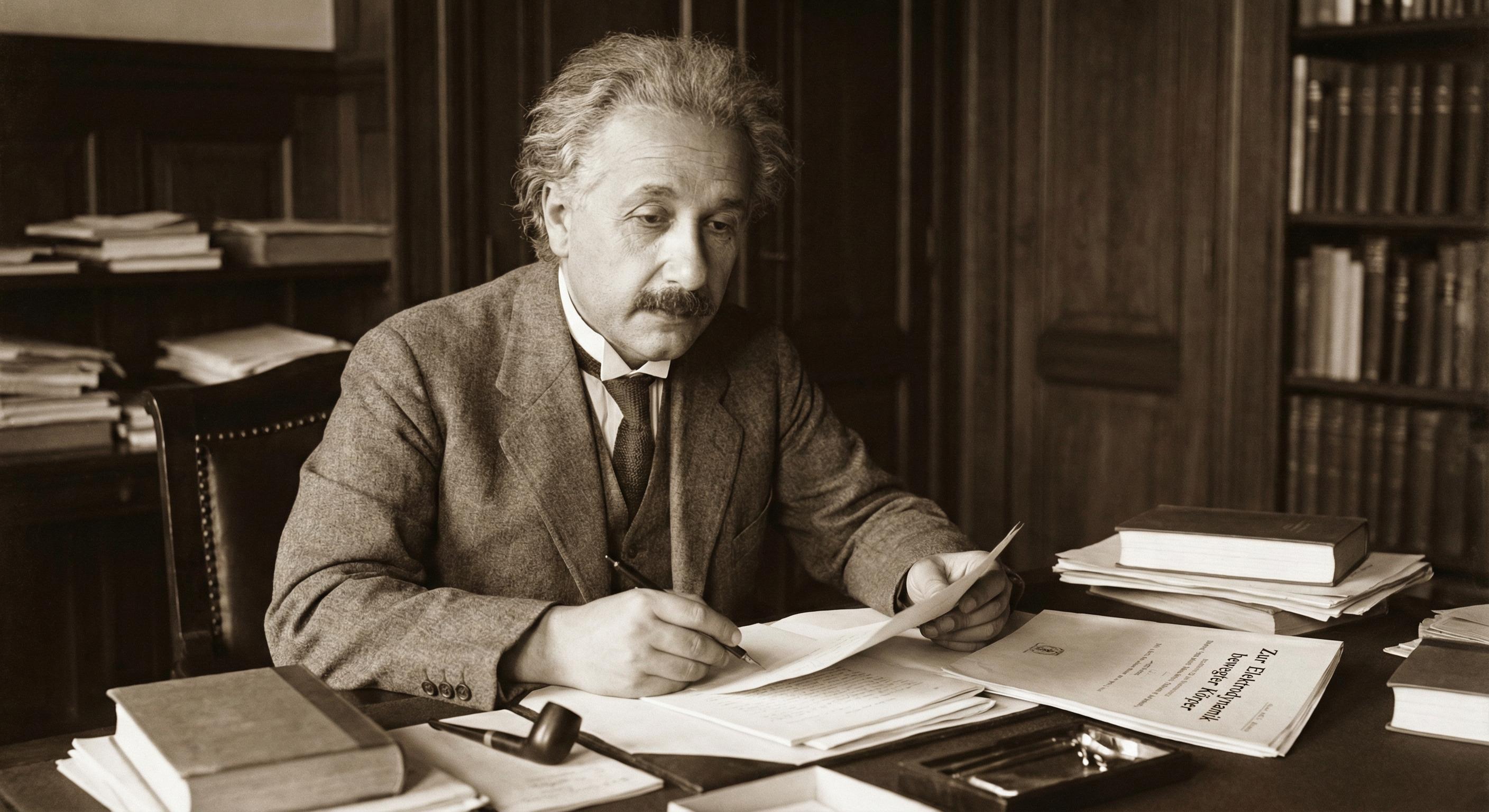
The story is often told like a genius leap (and it was), but it’s also a lesson in feedback. For everyday motion, Newtonian physics was enough. But when scientists pushed into extremes, the math disagreed with what the universe was doing. Einstein treated that mismatch as feedback and ran a gedankenexperiment, a thought experiment. He imagined chasing a beam of light and what he would actually observe. The thought experiment forced a conclusion: space and time weren't absolute, and special relativity was the result.4
Same learning loop, again.
Takeaway
If you keep only one thing, keep the loop:
Try → Get feedback → Update your mental model → Try again
The loop is only effective when you use it.
A few ways we use it:
- Before a deal: We define a thesis, use diligence to test assumptions, update our view of risk and value, then decide whether to pursue.
- Right after close: We enter with a 100-day plan, use an operating cadence as feedback, update priorities, then execute with more clarity.
- During ownership: We select top value drivers, test them in the business, refine the playbook, then scale the proven levers.
The context changes. The loop does not.
NASA screens for the learning loop because space punishes rigid thinking.
Google scaled it because markets reward fast learning.
Dweck framed it as growth mindset.
Einstein proved it when evidence forced a better model of reality.
It takes courage to see reality as it is, admit you were wrong, and adapt.
Because feedback wins.
- NASA, "The Cognition and Fine Motor Skills Test Batteries: Normative Data and Interdependencies," NASA Technical Memorandum (ntrs.nasa.gov)
- The Guardian, "Why Google engineers (and designers) can't always agree," The Guardian article (theguardian.com)
- Institute for the Humanities in the Sciences, "What Having a Growth Mindset Actually Means," ITHS PDF (iths.org)
- Norton, John D., "Chasing the Light: Einstein's Most Famous Thought Experiment," University of Pittsburgh (sites.pitt.edu)